On-Page SEO vs Off-Page SEO (Simple Explanation)
Introduction
Search Engine Optimization (SEO) is one of the most important parts of digital marketing. It helps websites rank higher on search engines and attract more organic traffic. However, SEO is not just one single process—it is divided into different types, mainly On-Page SEO and Off-Page SEO.
Many beginners often get confused between these two. Understanding the difference is very important because both play a crucial role in improving your website’s performance. In this blog, we will explain On-Page SEO and Off-Page SEO in a simple way, along with their importance, techniques, and key differences.
1. What is On-Page SEO?
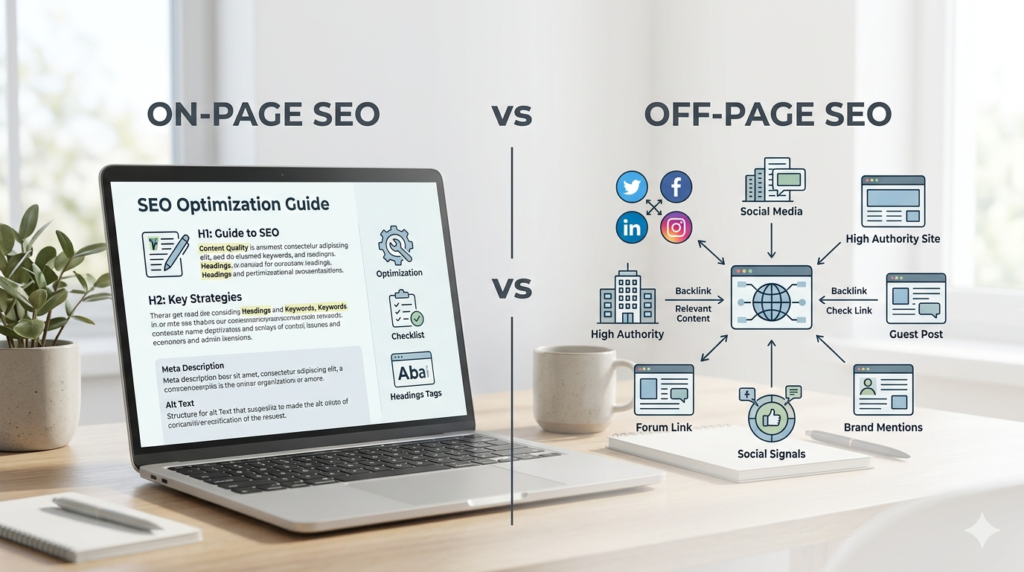
On-Page SEO refers to all the optimization techniques that are applied directly on your website. It focuses on improving the content, structure, and elements of your web pages to make them search engine friendly.
In simple words, On-Page SEO = Everything you control on your website.
2. Key Elements of On-Page SEO
1. Content Quality
Content is the most important factor in SEO. Your content should be:
- Useful and informative
- Easy to understand
- Relevant to the user’s query
Search engines prefer high-quality content that provides value to users.
2. Keyword Optimization
Using the right keywords helps search engines understand your content.
- Add keywords in title, headings, and content
- Avoid keyword stuffing
- Use natural language
3. Title Tag and Meta Description
- Title tag appears as the clickable link on search results
- Meta description is the short summary below the title
These elements help increase click-through rate (CTR).
4. URL Structure
A clean and simple URL improves SEO.
Example:
Good → yourwebsite.com/seo-tips
Bad → yourwebsite.com/page?id=123
5. Internal Linking
Linking one page to another within your website helps:
- Improve navigation
- Increase time spent on site
- Boost SEO performance
6. Image Optimization
- Use proper file names
- Add alt text
- Compress images for fast loading
7. Mobile Friendliness
Your website should work smoothly on mobile devices, as most users browse on phones.
8. Page Speed
Fast-loading websites provide a better user experience and rank higher on search engines.
3. What is Off-Page SEO?
Off-Page SEO refers to all the activities that are done outside your website to improve its ranking and authority.
In simple words, Off-Page SEO = Building your website’s reputation online.
4. Key Elements of Off-Page SEO
1. Backlinks
Backlinks are links from other websites to your website.
- High-quality backlinks improve ranking
- They act as a “vote of trust”
2. Social Media Marketing
Sharing your content on social media platforms helps:
- Increase visibility
- Drive traffic
- Improve brand awareness
3. Guest Posting
Writing articles for other websites helps in:
- Getting backlinks
- Reaching a new audience
4. Influencer Outreach
Collaborating with influencers helps promote your content and build trust.
5. Brand Mentions
When your brand is mentioned online, it increases credibility and authority.
6. Directory Submissions
Submitting your website to online directories helps improve visibility.
5. Key Differences Between On-Page SEO and Off-Page SEO
| Factor | On-Page SEO | Off-Page SEO |
|---|---|---|
| Definition | Optimization on your website | Activities outside your website |
| Control | Full control | Limited control |
| Focus | Content & structure | Authority & trust |
| Examples | Keywords, content, speed | Backlinks, social media |
| Purpose | Improve relevance | Improve credibility |
6. Why Both Are Important
Many beginners think they only need one type of SEO, but that is not true.
- On-Page SEO helps search engines understand your content
- Off-Page SEO builds trust and authority
Without On-Page SEO, your content won’t rank properly.
Without Off-Page SEO, your website won’t gain credibility.
Both work together to improve your ranking.
7. Best Practices for SEO Success
- Create high-quality content regularly
- Focus on user experience
- Build natural backlinks
- Avoid black-hat techniques
- Keep updating your website
Consistency is the key to SEO success.
8. Common Mistakes to Avoid
- Keyword stuffing
- Ignoring mobile optimization
- Buying low-quality backlinks
- Duplicate content
- Slow website speed
Avoiding these mistakes can improve your SEO performance.
Conclusion
On-Page SEO and Off-Page SEO are two essential parts of a successful SEO strategy. While On-Page SEO focuses on optimizing your website content and structure, Off-Page SEO helps build your website’s authority and trust in the online world.
Both are equally important, and ignoring either one can limit your growth. By understanding and applying both strategies effectively, you can improve your website’s ranking and attract more organic traffic.
Want to master On-Page and Off-Page SEO with practical strategies? Join Vidya Sarthi and learn step-by-step digital marketing skills to grow your website and career successfully. 🚀